
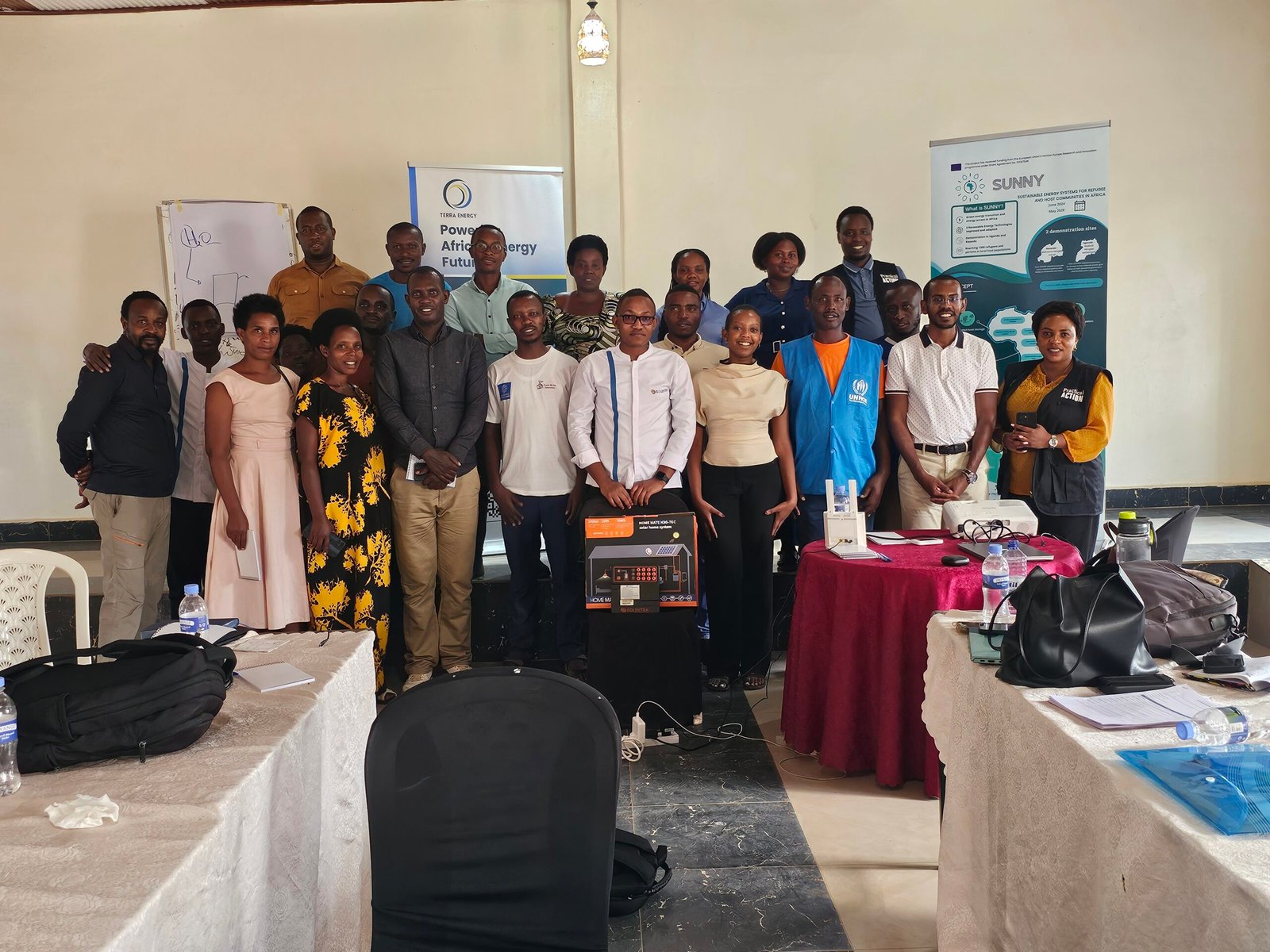
One of the suggestions from the day was to add a hook, so the hydrogen storage bag can hang up.
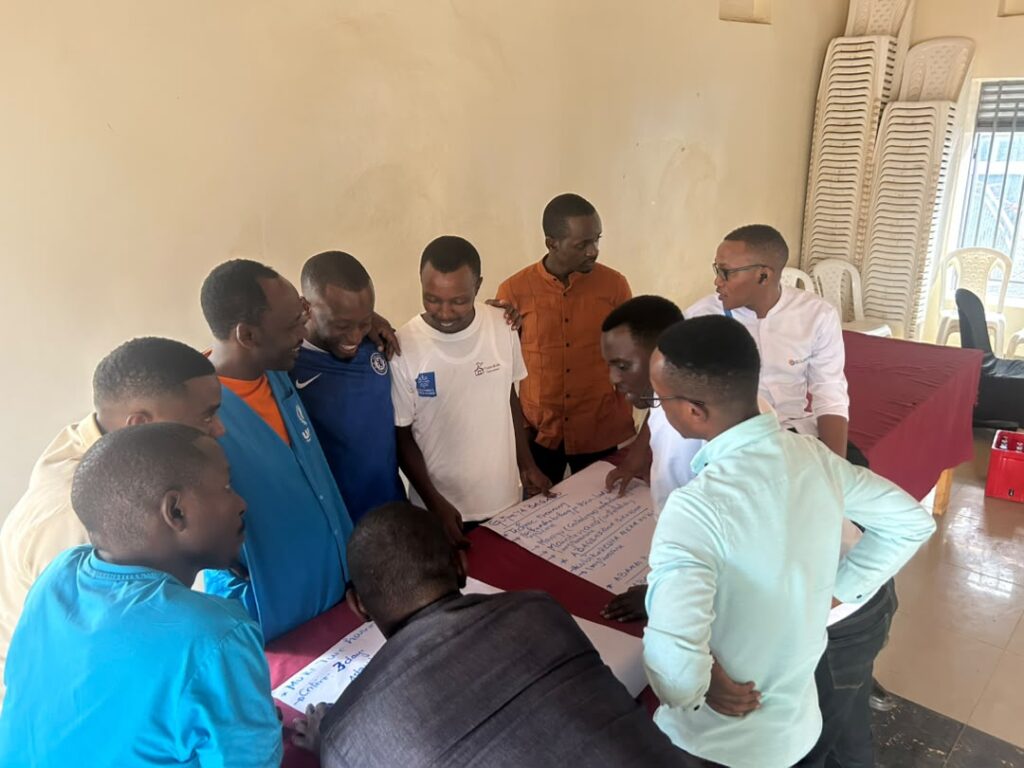
It is a small thing. It is also exactly the kind of thing that never appears in a technology specification written elsewhere, and exactly the kind of thing that determines whether a system gets used or gets left in a corner. On 23 July, SUNNY held a Multi-Actor Learning Lab in Mahama Refugee Camp to collect changes at that level of detail — and at every level above it.
Who was in the room
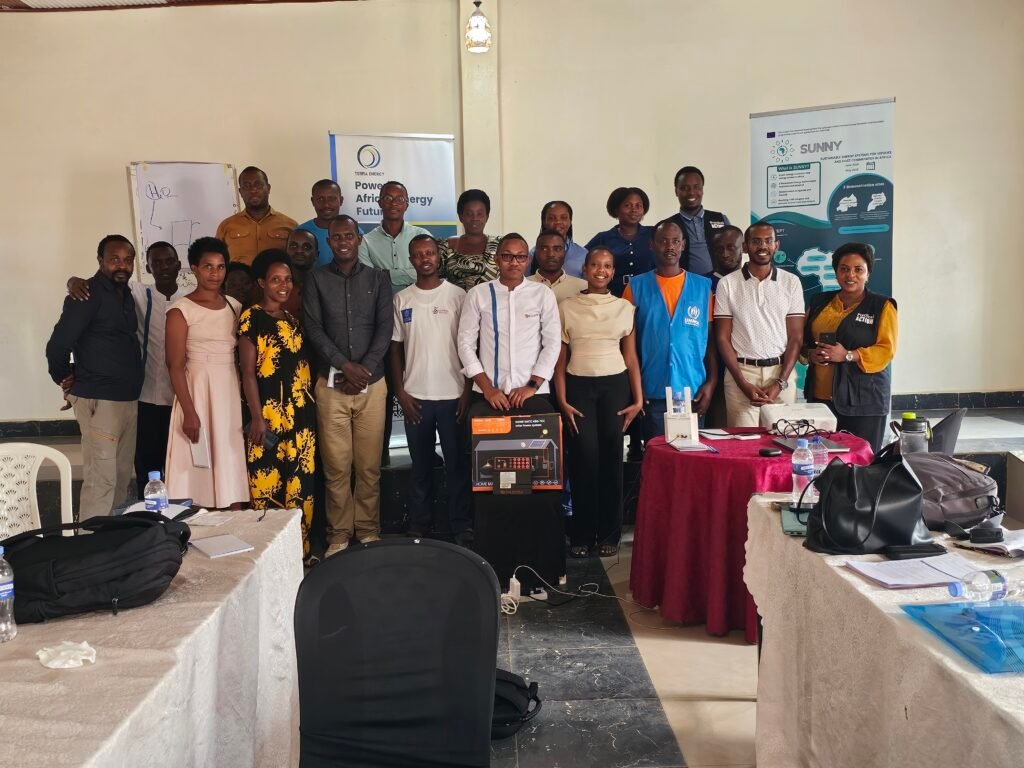
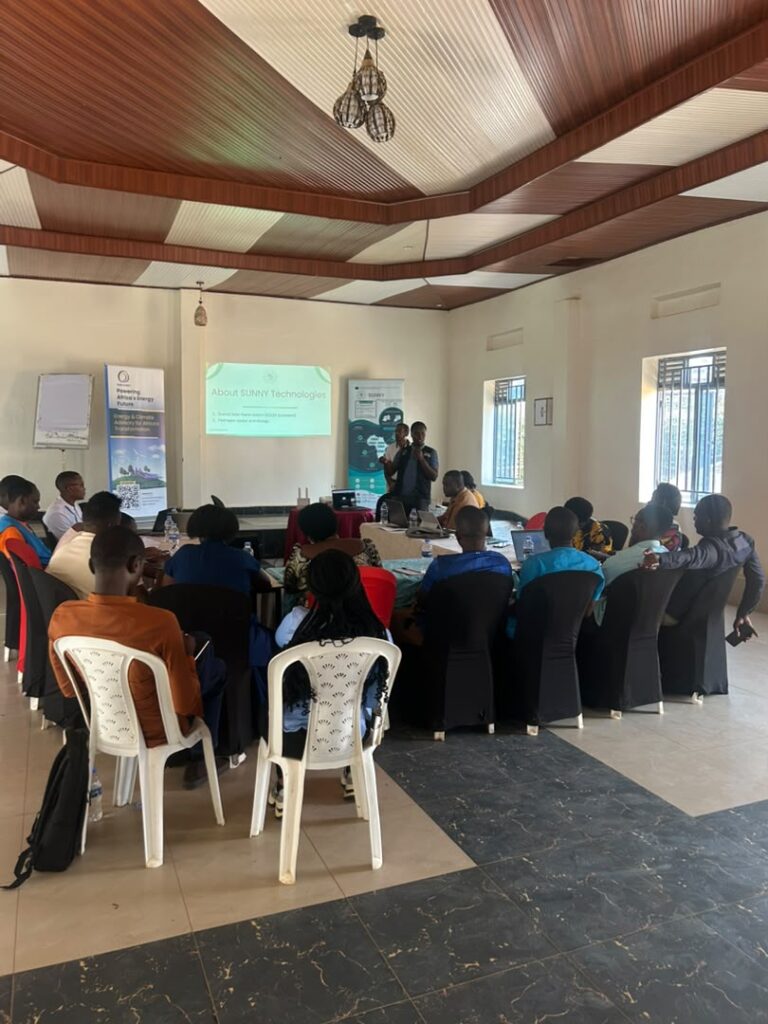
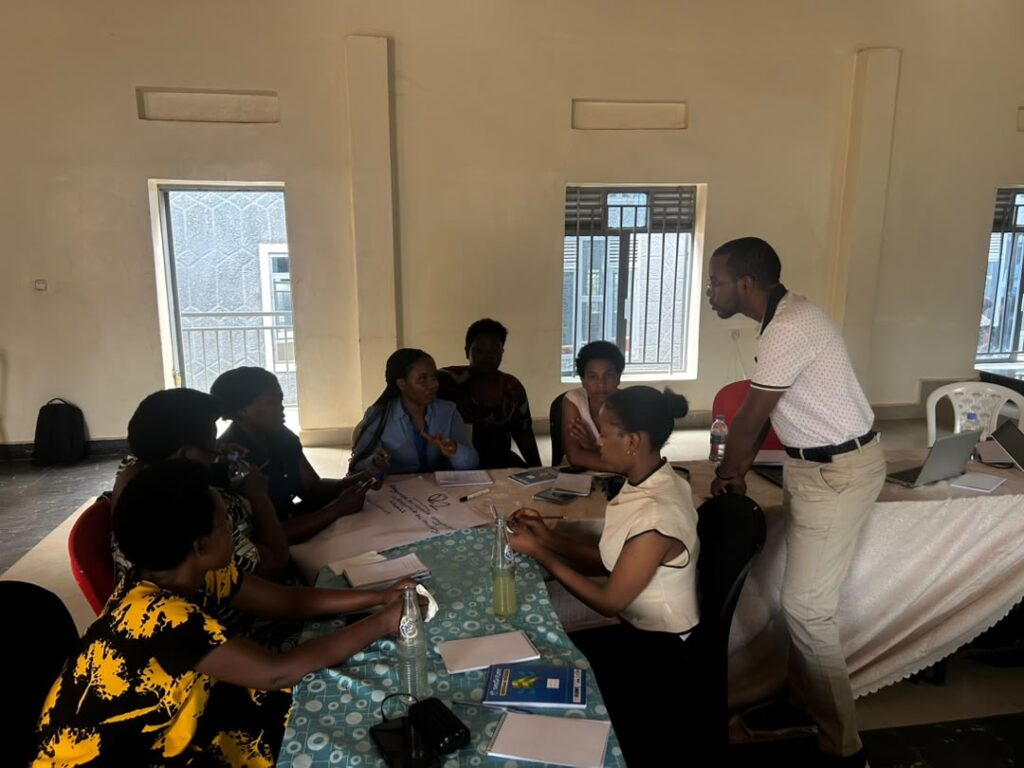
Thirteen people took part: eleven community representatives — five refugees and six from the host community, five women and six men — together with two project staff. Our partners Terra Energy organised the session, with Practical Action facilitating on the ground.
It was a small group by design, and the output density reflects it. Breakout groups were split with women convened separately, so that their input was captured distinctly rather than averaged into a mixed-group consensus. That decision produced findings that would otherwise have been lost — most notably on training delivery, further below.
Two technologies were put in front of the group for validation: a shared solar home system, developed by SOLEKTRA, and a hydrogen cooker and storage system.
What the community corrected: the solar system
The feedback on the solar home system was granular and almost entirely actionable.
Participants asked for a distinct audio alert for incorrect keypad entries, separate from any tamper or fault signal — so that a user’s own mistake isn’t confused with a system malfunction. On the tamper signal itself, the group did not converge: light, sound and image were all discussed, and the question remains open for SOLEK.
There was strong, repeated demand for wider appliance compatibility — laundry equipment, laptop charging and trimmers came up more than once, alongside a specific request for compatibility with a 12V DC iron. Participants then asked a question that pointed past the product entirely: where would they actually buy compatible appliances? That indicates a local supply-chain gap, and suggests something as simple as a recommended vendor list may need to ship alongside the hardware.
Questions on autonomy during cloudy days signalled a communications need rather than a design one: worst-case performance has to be stated clearly and realistically up front, rather than discovered in week three.
The most significant gap was commercial, not technical. The ownership and business model of the shared system were not well understood — particularly what happens to ownership once payments are complete. Terra Energy has identified the demonstration stage as the right moment to resolve this, in plain language and with visuals rather than text.
On misuse and tampering, participants were clear that consequences should be explicitly defined, and that responsible local structures should be informed when equipment is damaged. And they confirmed the upside: reliable power could support small income-generating activity, with phone charging named directly.
What the community corrected: the hydrogen cooker
Here, safety dominated.
Participants referenced prior LPG-related explosions and accidents and asked, reasonably, how a hydrogen system compares. The session ran over time on the volume of questions raised — a sign of high engagement, but also a sign that not every concern was fully resolved in the room. Participants want to see real-world examples of the technology working, which is a credibility question rather than a technical one, and one that a demonstration answers better than an explanation.
They also want to see it cook the food they actually eat, demonstrated live rather than asserted.
Practical questions clustered around the storage bag: how it gets repaired or replaced, what it weighs, what it costs. Participants proposed that bag design account for differing family sizes, so refill volumes match household need rather than a single default.
And then the group redesigned the distribution model. Rather than a single central production point, participants proposed decentralising to roughly one hydrogen production unit per eight households, cutting travel distance for refills — with community-based agents managing local bag exchange, and dedicated training for those agents.
That is not feedback on a product. That is a proposal about how the service should be structured, and it came from the people who would have to walk the distance.
The record that explains the scepticism
Underneath both discussions sat a consistent account of what has gone wrong before.
Participants described a clear mismatch between demand for renewable energy technologies and available supply. Previous donor and NGO-provided technologies were remembered for poor quality and robustness, with high failure rates — battery robustness cited specifically. After-sales service and slow repair turnaround came up repeatedly as a recurring pain point.
Battery theft was raised as a major and persistent problem. Participants’ response to it was constructive and pointed: users should not bear the full replacement cost when equipment is stolen, and a risk-sharing mechanism should be built into the business model rather than bolted on afterwards. That is now an input to WG4’s business model design.
The group made two further requests. They asked to be prioritised as beneficiaries of the pilot implementation. And they asked for visibility into how their feedback actually changes the design — a validation loop the project intends to close, at demonstration stage or through direct follow-up.
The training programme participants designed themselves
Asked how training should work, the group did not offer preferences. They specified a programme.
Three days: day one on the solar system, day two on the hydrogen cooker, day three for hands-on practice and handover, running roughly 09:00 to 15:00. Participants aged 18–45, with a gender balance target of approximately 60% female to 40% male. Attendance extending beyond direct users to technicians and local leaders — village, cell and social leaders, plus cooperative leaders — at indicative numbers of around 62 participants in-camp and 20 in the host community.
Content should cover how to use the equipment, how it works, how to maintain it, and — notably — the terms of agreement between buyer and seller. Participants want the commercial contract explained as part of the training, not separately from it.
Materials requested: pens and notebooks, visual teaching aids and a manual (imifashanyigisho), an equipment catalogue, and hands-on practical materials. A dedicated maintenance and installation track was requested alongside the general programme.
Participants recommended an explicit AGD approach — age, gender and disability — be applied to training design. And the Women’s Discussion Group flagged something specific: a rotating model where one leader or community member is trained at a time is not sufficient. They proposed mobilising volunteers to support elderly participants and to encourage wider participation, including by persons with disabilities.
On entrepreneurship training, participants proposed content by track. For hydrogen: business planning and project management, savings, finance and bank literacy, monitoring and evaluation, business leadership, innovation. For solar, they named the income-generating activities reliable power would enable — restaurant, hair salon, phone charging, cinema, delivery service.
What participants said afterwards
Ten of the eleven community participants completed the post-workshop survey, rating 26 statements across five dimensions. Respondents spanned ages 27 to 52, were close to gender-balanced, and included both refugee and host-community representatives.
Scores sat consistently at 4 and 5 across all five dimensions. Co-creation scored strongest and most uniformly of any dimension — participants felt the session genuinely built on their input. Capacity building was marginally more variable, which tracks directly with the requests for more training time.
Gender inclusion drew the most substantive open-text engagement. Most respondents framed it around equality — that everyone should be given equal opportunity, that no one should be left out, that both genders are capable. One female respondent framed it differently, and worth recording separately: that gender consideration matters because women are the ones who need this project most.
The suggestions were direct. Start on time — the single most repeated point, raised independently by several respondents. Extend the training from one day to three. Provide more hands-on materials and equipment during sessions. Include more visual aids and diagrams. And run training of trainers, to extend reach beyond the room.
We will take the timekeeping point first. It was the clearest piece of critical feedback we received, and it is the easiest to fix.
 English
  Français
  Kinyarwanda